

Types of reading accessories for books
Reading accessories are support items used with books that help improve the reading setup through practical assistance during reading sessions. These items are organized by accessory types based on function, including support, visibility, page tracking, marking, protection, and comfort. Each function addresses a different part of how readers interact with books in real use conditions.
Common reading frictions often appear during different reading setups, such as low-light environments, hand strain from holding books for long periods, or losing track of pages during longer reading sessions. Books may also get exposed to damage during transport or storage without protective items. In some cases, readers may struggle with maintaining consistent reading progress when marking or tracking tools are missing or unclear. These situations show why different reading accessories may be useful depending on reading habits and reading setup conditions.
This page classifies reading accessories into structured types rather than ranking or evaluating specific products. The focus stays on how accessory types relate to function and reading outcome, helping readers understand how each category supports a different reading need. This structure prepares a clear foundation for understanding how reading accessories connect to real reading setups.
What reading accessories are
Reading accessories are supporting items used with books or reading sessions that help structure, improve, or stabilize how reading takes place. They are not the main reading material and instead operate around books to support function, comfort, and usability. Their role is defined by how they assist reading through visibility, page tracking, marking, protection, or physical support during reading sessions.
Reading accessories are supporting items used with books or reading sessions that help improve reading conditions through function-based support, and they are commonly referred to as reading accessories.
 In practical reading setups, they may include a book light for low-light visibility, a bookmark for page tracking and reading progress, a book holder for hands-free stability, a book sleeve for protection during carrying, a reading pillow for comfort during longer reading sessions, and a page holder for maintaining page position. Each item connects to a specific reading function, and its usefulness depends on reading habits, reading environment, and reading setup conditions.
Reading accessories are distinct from the book itself and from decorative or unrelated book-themed objects. Their definition is based on their functional role in supporting reading sessions rather than acting as reading content or visual decoration. This boundary clarifies their scope as practical supporting items used around books in specific reading contexts.
Reading accessories versus reading tools, gadgets, and book decor
The distinction between reading accessories, reading tools, gadgets, and book decor depends mainly on function and practical effect during reading sessions. Reading accessories are classified by how directly they support books through usability, comfort, marking, or protection, while other categories shift based on whether the item actively assists reading or serves a different purpose. Classification depends on the item’s role in the reading setup and how it interacts with the reading task.

Many items appear ambiguous because they overlap in everyday use. A book light may function as a reading accessory when it improves visibility during reading sessions, while an ereader is more accurately treated as a reading device due to its electronic function. Decorative book items, by contrast, do not support reading function and belong to book decor even if they relate visually to books. This overlap shows that classification can change depending on practical effect and how the item is used in context.
In real reading setups, classification becomes clearer when each item is evaluated by role, dependency on the reading task, and functional outcome. Reading accessories, reading tools, gadgets, and book decor can be compared directly to identify boundaries and overlaps before assigning a category.
Comparison of categories by function and classification criteria:
| Label | Primary role | When it counts as a reading accessory | Boundary risk |
|---|---|---|---|
| Reading accessories | Support books during reading sessions | When used to improve comfort, marking, protection, or visibility in reading | Can overlap with tools when function becomes task-specific |
| Reading tools | Aid reading-related tasks | When the tool directly supports reading actions like tracking or holding pages | May shift into accessories depending on simplicity of use |
| Gadgets | Electronic or powered reading-related devices | When the device is used primarily to enable reading functionality | Overlaps with accessories when used as supportive lighting or display |
| Book decor | Decorative or aesthetic book-related items | Rarely counts unless it gains functional reading use | Usually non-functional, outside reading support scope |
Main types of reading accessories by function
Reading accessory types are best organized by function because function determines how each item supports reading sessions through lighting, visibility, support, hands-free stability, page holding, marking, tracking, protection, and comfort. These functional groups form the main type families: lighting and visibility, support and hands-free use, page holding and marking, protection and carrying, and comfort and positioning.

Some reading accessories may support more than one function depending on reading setup and usage context. For example, a reading stand can provide both support and hands-free positioning, while a book light may improve visibility and also assist reading comfort in low-light conditions. This overlap makes functional grouping the most stable way to understand classification before structured comparison.
Reading accessory types can be grouped by function families to compare their role and reading effect in a structured way.
| Function family | Common examples | Main attribute | Reading effect |
|---|---|---|---|
| Lighting and visibility | Book light, clip light | Illumination control | Improves page clarity in low-light conditions |
| Support and hands-free use | Book holder, reading stand | Stability and positioning | Reduces hand strain and stabilizes reading setup |
| Page holding and marking | Bookmark, page holder | Page tracking control | Maintains reading progress and page location |
| Protection and carrying | Book sleeve, cover | Surface protection | Reduces exposure to wear during transport or storage |
| Comfort and positioning | Reading pillow, support cushion | Ergonomic support | Improves posture and reading comfort in longer sessions |
Lighting and visibility accessories
Lighting and visibility accessories improve page clarity and line focus when reading takes place in low-light reading conditions or environments with uneven brightness. When text appears dim, shadowed, or difficult to follow across lines, visibility becomes dependent on controlled lighting and placement rather than ambient conditions alone.
Lighting and visibility accessories depend on key attributes such as brightness, contrast, adjustability, and placement to support clearer reading output. A book light or reading light can improve page clarity by directing focused illumination, while magnifiers and focus aids can help maintain visual detail and line tracking under reduced contrast conditions. These outcomes vary depending on setup and reading environment, so suitability is conditional on usage context.
Lighting and visibility accessories may be grouped under visibility and focus accessories when broader control of reading clarity and focus support is required beyond basic illumination adjustments.
- Book light — improves brightness and supports low-light reading by directing focused illumination toward the page
- Reading light — supports adjustable brightness and placement to reduce glare and improve page clarity
- Magnifier — increases perceived text contrast and supports reading of fine details in low-clarity conditions
- Focus aid — supports line focus and reading alignment when visibility is reduced or inconsistent
This chart shows the main types of lighting and visibility accessories and their purpose in improving page clarity and line focus under low-light conditions.

Book support and hands-free accessories
Book support and hands-free accessories address the difficulty of holding books steadily for extended reading sessions, especially when hand strain, shifting pages, or unstable positioning occurs on a lap or desk. When the book cannot maintain a fixed angle or grip, reading flow becomes inconsistent and requires constant adjustment. These accessories solve this by introducing external physical support that stabilizes the reading position without relying on continuous hand effort.
Book support depends on where the book is positioned and how stability is achieved across different reading surfaces. A book holder typically maintains grip and page angle on a desk, while a book stand provides elevated hands-free support for more structured setups with consistent viewing height. A reading pillow supports softer surfaces like a lap or bed, helping maintain position when rigid support is not available. Fit depends on book size, surface type, and required angle stability during the reading session.
In cases where reading extends beyond basic positioning and moves toward longer-duration comfort use, book support can be related to comfort reading accessories that extend stability into sustained reading conditions.
This chart shows the main types of hands-free book support accessories grouped by surface type and the key factors to consider when choosing one.

Page holding, marking, and tracking accessories
Page-control accessories help when readers lose their place, struggle to keep a page open, or need a consistent way to follow reading progress across multiple sessions. These issues usually come from unstable page positioning or the lack of a clear return point. Page holding, marking, and tracking accessories solve this by creating structured ways to preserve place, section reference, and reading continuity as part of the page-control function.
Page holding, marking, and tracking accessories work through three distinct functions: page holding stabilizes the book in an open position, marking creates a visible reference point on a page, and tracking records reading progress over time. This separation clarifies how each tool interacts with the page differently, whether by physical support, visual indication, or progress recording. The difference depends on whether the goal is stability, reference, or continuity.
Page-control accessories can be grouped into bookmarks, page holders, tabs, and reading trackers, depending on how they interact with the page and reading flow. These tools differ in whether they physically affect the page or only support navigation across reading sessions. This distinction is further explained in page tracking accessories, where tracking and marking behaviors are connected to broader reading continuity patterns.
- Bookmark — preserves place without altering the page, used as a removable reference point for returning to a specific location
- Page holder — keeps pages physically open, stabilizing the book during hands-free or desk-based reading
- Tabs — mark sections or divisions on pages, partially modifying page edges for faster navigation
- Reading tracker — records reading progress without changing the page, used for multi-session continuity
- Annotation — adds notes or markings directly on the page, altering page content for reference use
This chart shows the three distinct functions of page-control accessories—page holding, marking, and tracking—and the tools that serve each function.

Book protection and carrying accessories
Book protection and carrying accessories support situations where a book is carried in a bag, held in hand, or moved between locations, where surface contact, pressure, or friction can increase damage risk. These conditions often lead to edge wear or surface scuffing if no protective layer is used. In this context, protection functions as a buffer layer that supports safer carrying and handling of books during movement.
Book protection depends on coverage, carrying condition, and how the accessory interacts with external pressure during transport. A book sleeve usually provides full external coverage, while a pouch or cover may reduce direct surface exposure depending on thickness and fit. A case can add more structured support during transport, but portability and protection levels vary based on material and carrying environment. These accessories focus on coverage rather than long-term storage or maintenance conditions.
- Book sleeve — provides full surface coverage and reduces friction during carrying inside bags
- Book pouch — offers soft enclosure that limits direct contact and supports portable carrying conditions
- Cover — protects outer surfaces and reduces exposure to light handling damage risk
- Case — adds structured protection and helps stabilize the book during transport conditions
Comfort and reading-position accessories
Comfort and reading-position accessories support reading when grip stability, reading angle, or session length creates fatigue during use. These conditions often appear when reading is done on soft surfaces or when the book must be held for extended periods without consistent support. Comfort-position accessories address this by adjusting how the book is supported, angled, or held, depending on reading position and usage context.
Comfort depends on support point, adjustability, reading position, and body context, especially when using reading pillow, lap support, thumb holder, or book stand to manage angle and grip during reading. These accessories can reduce effort by stabilizing the book or improving hand control, but the effect varies based on surface type, session length, and adjustment needs. Fatigue may increase when support does not match the reading position or when adjustability is limited.
Comfort and reading-position accessories depend on several conditions that influence fit and stability during use:
- Body position — affects how reading pillow or lap support distributes weight and stability
- Reading surface — determines whether book stand or cushion support can maintain angle control
- Session length — influences fatigue levels and need for grip or support adjustment
- Support point — defines whether hand, lap, or surface carries the reading load
- Adjustment need — varies based on how often angle or grip must be corrected
When ordinary comfort accessories are not sufficient for maintaining stable reading position or managing fatigue, support needs may shift toward accessible reading support depending on the reader’s condition and setup requirements.
What each accessory type changes during reading
Reading friction often appears when visibility is limited, pages are difficult to manage, books are uncomfortable to hold, or reading progress becomes harder to maintain. Different accessory types address different conditions within the reading session rather than solving the same problem. Each accessory type changes a different part of the reading session.
An accessory type can improve one reading session while adding unnecessary clutter in another because reading habits, environments, and preferences differ. What each accessory type changes during reading depends on the reading friction involved and the practical outcome being sought. The table below organizes each accessory family by changed condition, typical benefit, and limitation or trade-off.
| Accessory family | Reading friction changed | Typical benefit | Limitation or trade-off |
|---|---|---|---|
| Visibility | Low light, glare, reduced page clarity | May improve visibility and support reading focus | Can depend on lighting conditions and setup preferences |
| Support | Hand strain, unstable reading position | May improve stability and reduce holding effort | Can require additional space or may not suit every reading position |
| Page control | Losing place, interrupted continuity | May support progress tracking and page continuity | Can add extra items to manage during reading |
| Protection | Carrying-related damage risk and surface exposure | May reduce exposure to friction during handling | Can increase bulk or reduce immediate access to the book |
| Comfort | Fatigue from reading position or grip effort | May support a more stable and comfortable reading setup | Benefits depend on body context, surface type, and session length |
| Tracking | Difficulty monitoring reading progress | May support continuity across multiple reading sessions | Can introduce an additional tracking step or routine |
Accessory types that readers often confuse
Accessory types often confuse readers because overlapping functions and naming overlap can make different reading accessories appear similar even when they change different conditions during a reading session. Book lights, book holders, book stands, and page holders may share a related purpose, but each has a different distinguishing attribute. The correct interpretation comes from comparing the shared function with the specific condition each accessory type is designed to address.
Similar names do not always mean identical use, and product naming can vary across publishers, retailers, or manufacturers. A shared function may create common confusion, while the actual outcome depends on visibility, support, stability, or page control. The comparison below highlights local type distinctions that help separate overlapping functions without treating similar accessories as the same category.
| Confused pair | Shared function | Main difference | When the distinction matters |
|---|---|---|---|
| Book lights vs book holders | Support the reading session | Book lights focus on visibility and brightness, while book holders focus on physical support and stability | When page clarity is the main issue rather than hands-free positioning |
| Book holders vs book stands | Provide support for reading | Book holders emphasize stability, while book stands may place greater emphasis on angle adjustment and viewing position | When adjustability becomes more important than basic support |
| Book holders vs page holders | Help keep a book usable during reading | Book holders support the book body, while page holders focus on page control and keeping an open book in position | When maintaining page position matters more than supporting the entire book |
| Page holders vs bookmarks | Support reading continuity | Page holders assist during active reading, while bookmarks preserve place between reading sessions | When distinguishing page control from progress marking |
Book lights versus book holders
Book lights solve visibility challenges, while book holders solve physical support challenges during a reading session. A book light improves page clarity in low-light reading conditions, whereas a book holder helps maintain stability and hands-free positioning. Because visibility and physical support address different needs, both accessories may be useful together in a combined setup.
In low-light reading conditions, a book light may help when page clarity is limited by available brightness. In hands-free reading situations, a book holder may help stabilize the book and reduce the need for continuous hand support. The comparison below contrasts function, deciding condition, limitation, and combined use for book lights versus book holders.
| Book light | Book holder | |
|---|---|---|
| Main function | Supports visibility and page clarity through added brightness | Provides physical support and stability for the book |
| Best condition | Low-light reading or reduced page visibility | Hands-free reading or situations requiring stable positioning |
| Limitation | May improve visibility without addressing support needs | May improve stability without changing page brightness |
| When both can work together | Can be combined with a book holder when both visibility and support are needed | Can be combined with a book light when stability and page clarity are both important |
Book holders, book stands, and page holders
Book holders, book stands, and page holders differ by the supported part and the type of physical support they provide. A book holder usually supports the book body, a book stand often supports both the book body and reading angle, and a page holder focuses on page control through grip. The distinction depends on whether support is directed toward the book body, reading angle, or open pages.
Naming overlap can make a book holder, book stand, or page holder appear similar even when the supported part is different. Depending on design, a holder may overlap with a stand, and a page holder may use a thumb grip or page clip to hold open pages. The table below compares supported part, support attribute, suitable condition, and common overlap.
| Item | What it supports | Main attribute | Suitable condition | Common overlap |
|---|---|---|---|---|
| Book holder | Book body | Physical support and stability | When steady book support is needed | May overlap with a book stand when both stabilize the book |
| Book stand | Book body and reading angle | Angle control and surface stability | When viewing position depends on reading angle | May overlap with a holder depending on structure and support level |
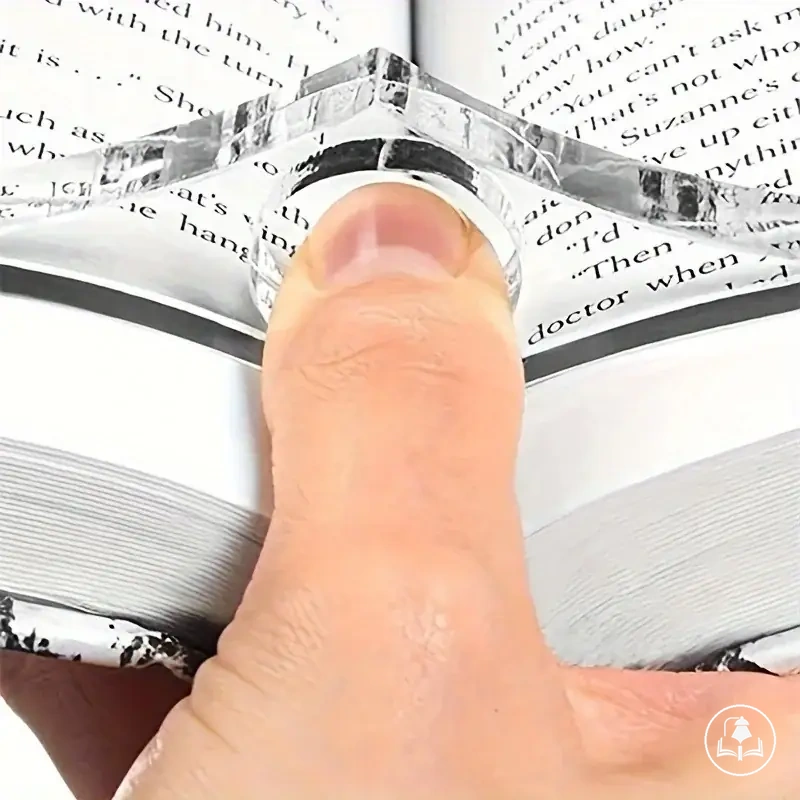
| Page holder | Open pages | Grip and page control | When keeping pages open is the primary condition | May overlap with a page clip or similar page-control holder |
Essential and situational reading accessories
Essential reading accessories depend on need rather than popularity. An accessory becomes essential when it solves a reading habit, location, or constraint that affects the reading session, while situational accessories only matter under specific conditions. The decision outcome should follow need, condition, and practical usefulness.
Reading habit, location, and book format often determine whether an accessory is broadly useful, condition-dependent, or unnecessary for some readers. Low-light reading may increase the need for lighting, while longer sessions may increase the value of support or comfort. Frequent carrying may make protection more relevant, while marking and tracking depend on how the reader manages reading progress. Essential and situational reading accessories should therefore be shortlisted by condition rather than popularity.
Common reading frictions point toward different accessory types: visibility problems may point toward lighting, hand strain may point toward support or comfort, page-control issues may point toward marking tools, carrying exposure may point toward protection, and progress habits may point toward tracking. These choices still involve trade-offs because an accessory can solve one constraint while adding bulk, setup time, or extra handling.
- Reading location — check whether the usual location creates lighting, space, or carrying constraints
- Lighting — decide whether visibility problems make a lighting accessory useful
- Hand support — check whether grip, support, or comfort affects longer sessions
- Page control — decide whether marking or page holding improves continuity
- Book protection — check whether carrying conditions increase damage risk
- Tracking habit — decide whether recording reading progress supports the reader’s routine
- Accessibility or comfort constraints — check whether ordinary accessories are enough for the reading setup
A practical shortlist should include broadly useful accessories only when they match a recurring need and exclude situational accessories when the condition rarely appears. Readers can choose the right reading accessories by matching each accessory type to reading habit, location, constraint, and decision outcome before adding products to compare.
The products below are useful examples for comparing available options. Before buying, check that the compatibility criteria, key features, and product details match your needs.




This chart shows how to decide between essential and situational reading accessories based on need, condition, common frictions, and a practical shortlist rule.

Combining reading accessory types in one setup
Combining reading accessory types can create clutter when different items duplicate the same function or compete for the same space in a reading setup. A balanced setup solves separate reading problems instead of adding accessories for every possible use. The strongest combination is one where distinct functions work together without unnecessary overlap.
Lighting plus support may help when low-light reading also needs hands-free stability, while support plus page control may help when the book must stay open and steady at the same time. Protection plus tracking may be useful when books are carried often and reading progress needs to continue across locations. These combinations work best when each accessory covers a different function, because overlap can add clutter without improving the practical outcome.
- Distinct problem — check that each accessory solves a separate reading friction
- Function coverage — confirm that lighting, support, page control, protection, or tracking is not duplicated unnecessarily
- Reading location — choose combinations that fit the actual place where reading happens
- Storage practicality — avoid paired accessories that are difficult to store, carry, or keep nearby
- Ease of use — keep the setup simple enough to use without interrupting the reading session
The practical next step is to start with the main friction, then add only the accessory type that covers a second distinct need. Useful pairs should reduce friction in the reading setup, while optional add-ons should be excluded when they mainly add clutter or duplicate function coverage.
The products below are useful examples for comparing available options. Before buying, check that the compatibility criteria, key features, and product details match your needs.
This chart shows how to combine reading accessory types effectively, highlighting the risk of clutter from duplication, strong pairings, and key checks to evaluate combinations.
